 Anito Connect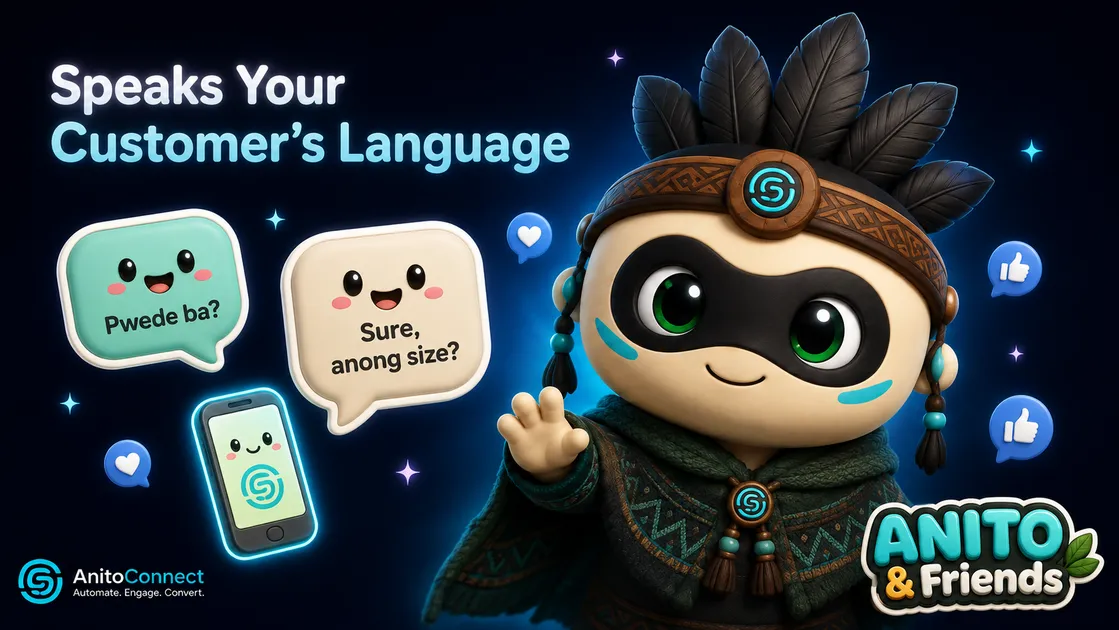
"Bakit English pa ang reply nila?" — Why Language Mismatch Loses Sales
A customer in Cebu messages your shop in Bisaya. They ask about your price, your availability, maybe whether you do Cash on Delivery. Your page replies in stiff, templated English.
They don't complain. They just leave. Baka nagshopping na sa ibang seller.
That silent exit is one of the quieter sales leaks Filipino small businesses deal with — and it's almost never talked about.
Why Language Comfort Drives Buying Decisions
The Philippines has over 180 languages and dialects. Cebuano alone has tens of millions of native speakers spread across Visayas and Mindanao — a massive, buying-ready market that many Metro Manila-centric SMBs serve awkwardly at best.
When a customer messages in their mother tongue, they're not just choosing words. They're signaling how they prefer to be treated. Replying in English — or worse, an obviously automated canned message — breaks that signal immediately.
Comfort builds trust. Trust closes sales. It's that simple.
This is especially true in social commerce, where the entire transaction happens inside a casual conversation on Facebook Messenger. There's no product page to anchor confidence, no cart flow to guide them. The conversation is the storefront. If it feels cold or foreign, they bounce.
"Can an AI really reply naturally in Bisaya and Taglish?"
This is the most common question SMB owners ask when they first hear about Facebook Messenger automation. The honest answer: it depends entirely on how the tool is built.
Most generic chatbots are trained on English. They handle Tagalog awkwardly, Taglish inconsistently, and Bisaya almost not at all.
Anito Connect — a Facebook Messenger automation tool built specifically for Filipino SMEs — is designed from the ground up for how Filipino customers actually type. That means:
- Cebuano/Bisaya replies that sound natural, not translated
- Tagalog and Taglish that flows the way your suki actually speaks
- English when the customer switches to it — automatically, mid-conversation
- Warm, human tone across all of these — never robotic, never stiff
The system reads the customer's language and matches it. You don't configure anything. It just works.
The August–September window is worth paying attention to
It's the last day of August. 'Ber months are officially here, and buying behavior shifts noticeably. More people are researching gifts, planning events, booking services for year-end. Customer messages pick up — and so does the diversity of where those customers are messaging from.
If your business sells nationally (and most Facebook-active SMBs do, whether they realize it or not), you're already receiving messages from Davao, Cebu, Iloilo, Cagayan de Oro. The question is whether your inbox is ready to make them feel at home.
Meta's own data has consistently shown that Messenger response speed and quality are directly tied to customer purchase confidence. Language comfort is part of that quality equation.
The DTI Philippines continues to push digital inclusion for regional micro and small enterprises — part of that is meeting customers in their own language, on platforms they already use.
What this looks like in practice
Imagine a customer in Mandaue City messages your online shop at 9PM:
"Pwede ba mag-order ug isa? Bayad sa COD?"
Instead of silence until morning — or a generic English autoresponse — they get an immediate, warm reply in Bisaya confirming the item, the COD process, and asking for their delivery address.
That customer doesn't wonder if you're legit. They don't second-guess. They order.
That's Anito Connect doing what it's built for: being the unseen guardian of your shop, speaking your customer's language, at any hour.
If your inbox only speaks one language, it's probably leaving money on the table every single day.
Want to see how Anito Connect handles multilingual customer messages for your business? Book a free walkthrough — no pressure, no jargon.